
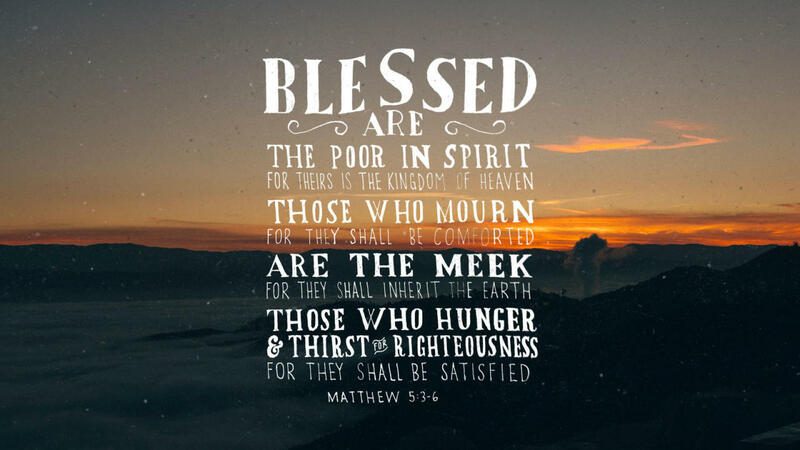
Matthew 5:1-12
Revelation 7:9–17
Think of some saints you know of and admire. Who comes to mind?
Mother Teresa? Saint Francis of Assisi? Saint John Paul the Second?
The twelve apostles – not including Judas, but did you remember the
one who replaced him – Matthias?
There are so many saints beyond the ones in our Bibles and the roster
of God’s holy servants on the calendars kept by our Roman Catholic
sisters and brothers. Countless saints – who lived in faith and died in
faith. And then, there are the ones who are still walking around with
us.
The communion of saints that we speak of in the Apostles’ and Nicene
Creeds started with God’s first calling to human beings to be in a
covenantal relationship with God – and it extends all the way into
eternity. That communion is sustained entirely by the grace of God.
Some of them are biblical giants: Noah, Abraham, Isaac, Jacob,
Joseph, the prophets, some of the kings (my favorite being David –
even though he was no angel), and the disciples. But there are
countless other heroes of the faith who lived and died after the ministry
of Jesus – including the ones we remembered this morning.
But John’s vision in The Revelation goes way beyond the giants of the
faith. He sees a great multitude – more people than anyone could
count – and more varied than anyone could imagine: “from every
nation, tribe, people, and language.” That’s a pretty extensive list.
They are the saints – who have endured trials and tribulations, and
who are now resting from their work – and who will share in Jesus’s
glory forever and ever.
But how do we get from the small, struggling, band of disciples on a
Galilean hillside in Matthew 5 to the un-countable throng around the
throne of God in Revelation 7? John tells us they are the ones who
came out of the "great tribulation." They have experienced the friction
and the frustration of living out the Beatitudes in a hostile world.
The reality is that the saints in Revelation 7 and in our hymn today are
not superhumans. They are ordinary people who have been shaped
by earthly trials, washed in the blood of Jesus, and gathered into a
place where all they can do is celebrate God’s good gifts to them.
Which does not – contrary to what purveyors of a prosperity gospel
might tell you – mean that they had it easy in this life. Much more
likely, they suffered. They were the meek, the mourning, and the
merciful – as well as the pure in heart, the peacemakers, and the
persecuted.
But these are not badges of achievement; they are descriptions of the
life of a believer in a fallen world. To be a saint in the making is NOT
floating off the ground so that you don’t get your feet dirty. Saints in
training get both their feet AND their hands dirty, and they experience
grief, weakness, frustration, and rejection – like everyone else.
To live otherwise is to sell out to godless worldly power or the lie of
self-reliance. The right path is one of dependence on God. If you feel
weary, broken, or out of step with the world's values, you are probably
walking right in the footprints of Jesus.
We see that truth in the small crowd that turned out to hear Jesus –
not in a stadium, not in a cathedral, not even in a small, country
chapel. Rather, He met with them along country roads, on hillsides,
and in wayside inns.
But through His humility – Jesus has gathered a following that John
describes in the Revelation as "a great multitude that no one could
count" – from every nation, tribe, people, and language.
They are standing before the throne and the Lamb, wearing white
robes, holding palm branches – symbols of victory and peace.
And what do we learn from that crowd? That the family of God is
infinitely bigger and wider and more diverse and comprehensive than
our human imagination – and certainly larger than our local
congregation or worship space.
When the Church feels too small, too fractured, or declining on earth,
The Revelation reminds us of the massive, global, multi-generational,
and eternal reality of God’s redemptive work.
John says the multitude is made up of those who came out of the
"great tribulation" – not a one-time event, as some promote – but
the ongoing challenge of living out the Beatitudes in a hostile world
over the centuries – all the while remaining faithful.
He also says, "They have washed their robes and made them white in
the blood of the Lamb." Any of you who have experience doing
laundry know about blood stains – so you are probably wondering how
blood could make robes white.
That is the paradox of our salvation: the death of the eternal Son of
God gives us eternal life. And His shed blood washes us white as
snow in God’s sight.
Ultimately – it is all on Jesus to make people saints and to keep them
as a holy people for Himself. We cannot earn salvation by keeping all
of the law – or even by laying our lives down for our faith – rather, it
comes to us as God’s gift through the atoning sacrifice of His Son,
Jesus Christ.
But wait – there’s more! The future that Jesus has prepared for us
includes:
No more hunger or thirst.
No scorching heat.
The Lamb will be our shepherd, guiding us to springs of living water.
God will wipe away every tear from our eyes.
And our white robes will be a gift, not something we earned.
One day, we will join that un-countable host of the saints.
Until then, let’s keep our eyes on the Lamb – so that we can stay
faithful and become more and more like Him – more saintly –
as He guides us to eternity.
Amen.