
Isaiah 45:1-7
“This is what the Lord says to his anointed,
to Cyrus, whose right hand I take hold of
to subdue nations before him
and to strip kings of their armor,
to open doors before him
so that gates will not be shut:
2 I will go before you
and will level the mountains [a] ;
I will break down gates of bronze
and cut through bars of iron.
3 I will give you hidden treasures,
riches stored in secret places,
so that you may know that I am the Lord,
the God of Israel, who summons you by name.
4 For the sake of Jacob my servant, of Israel my chosen,
I summon you by name
and bestow on you a title of honor,
though you do not acknowledge me.
5 I am the Lord, and there is no other;
apart from me there is no God.
I will strengthen you,
though you have not acknowledged me,
6 so that from the rising of the sun
to the place of its setting
people may know there is none besides me.
I am the Lord, and there is no other.
7 I form the light and create darkness,
I bring prosperity and create disaster;
I, the Lord, do all these things.
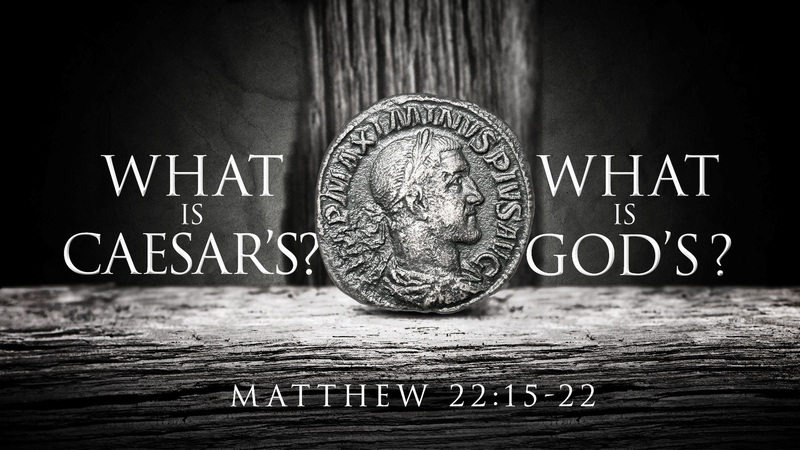
Matthew 22:15-22
15 Then the Pharisees went out and laid plans to trap him in his words.
16 They sent their disciples to him along with the Herodians. “Teacher,”
they said, “we know that you are a man of integrity and that you teach
the way of God in accordance with the truth. You aren’t swayed by
others, because you pay no attention to who they are. 17 Tell us then,
what is your opinion? Is it right to pay the imperial tax [a] to Caesar or
not?” 18 But Jesus, knowing their evil intent, said, “You hypocrites, why
are you trying to trap me? 19 Show me the coin used for paying the tax.”
They brought him a denarius, 20 and he asked them, “Whose image is
this? And whose inscription?” 21 “Caesar’s,” they replied.
Then he said to them, “So give back to Caesar what is Caesar’s, and
to God what is God’s.” 22 When they heard this, they were amazed. So
they left him and went away.
The first of the amendments to the Constitution of the United States
makes it clear that there is to be no official religion. Our forefathers,
many of whom left European countries for the new world to escape
persecution based on their religious beliefs and practices – and so the
framers of Constitution made freedom of religion the very first principle
in the Bill of Rights:
"Congress shall make no law respecting an establishment of religion,
or prohibiting the free exercise thereof …”
From the get-go of our fledgling nation, our leaders recognized that
some parts of our lives can be governed by the civil authorities, and
some must never be governed by the civil authorities.
I suspect our founding fathers were influenced by Jesus’s response to
the Pharisees and the Herodians, who were trying to trap Him into
saying something that would get Him into trouble – either with the
Roman government or with the people who were chafing under the
Roman occupation and unfair system of taxation.
The Pharisees despised the Roman occupiers and the oppressive and
corrupt system of collecting taxes, while the Herodians collaborated
with the occupiers to gain political advantage. The two parties could
not agree on much – but they did agree that they had to do something
about this Jesus, who was chipping away at their influence.
Jesus’s well-thought-out response is our North Star in trying to
navigate the tension between our responsibility to God and our civic
responsibilities. It helps us to answer the question, “How do we live as
faithful citizens of the Kingdom of God while operating within worldly
systems of government?”
Earthly leaders like Caesar have a legitimate, temporary sphere of
governance. While God in His Providence established the authority of
human leaders, God still holds absolute and supreme sovereignty over
all nations, history, and human hearts. In other words, giving Caesar
his due must always be subordinate to giving God our total allegiance.
The Westminster Assembly – called by the British Parliament in 1642 –
spent ten years wrestling with the question of how to reform and
restructure the Church of England. Theologians and members of
Parliament – along with some Scottish representatives – produced
the Westminster Confession of Faith, as well as the Larger and Shorter
Catechisms, and a directory for church worship and governance.
This is what the Westminster Confession of Faith – part of our
Presbyterian Book of Confessions – says about the relationship
between church and state:
God, the Supreme Lord and King of all the world, hath ordained civil
magistrates to be under him over the people, for his own glory and the
public good; and to this end, hath armed them with the power of the
sword, for the defense and encouragement of them that are good, and
for the punishment of evil-doers.
It is lawful for Christians to accept and execute the office of a
magistrate when called thereunto; in the managing whereof, as they
ought especially to maintain piety, justice, and peace, according to the
wholesome laws of each commonwealth, so, for that end, they may
lawfully, now under the New Testament, wage war upon just and
necessary occasions.
The delegates to Westminster understood the trap of divided loyalties –
and leaned heavily upon Jesus’s response of, “Whose image is on the
coin?” “Caesar’s” – “So give to Caesar the things that are Caesar’s and
to God the things that are God’s.”
So we still have to pay taxes, obey speed limits, and otherwise live by
the rule of law. Sorry about that, folks. And we also have to give to
God what is rightfully God’s.
Because every good and perfect gift comes to us from God, then we
owe God everything. Of course, we could never give God everything –
but we can use everything we have for God’s glory. That includes our
time, our abilities, our passions, our hobbies, our finances, and most of
all – our faith and our love.
So we walk out of here today as responsible citizens of the United
States, but we live primarily as faithful citizens of the Kingdom of
heaven and children of the God who formed us in His image and
bought us with His blood. Amen.