
Psalm 23 & Matthew 22:1–14
You have probably heard the opposite of today’s sermon title:
“You can dress them up, but you can’t take them out” – which is a
way of saying that someone is rough around the edges or not refined
enough to take to a formal gathering.
George Bernard Shaw wrote a play about someone like that – My Fair
Lady. In it, a phonetics professor – Henry Higgins – takes a Cockney
flower girl named Eliza Doolittle and, and tries to polish this diamond in
the rough.
The point is that we can put nice clothes on someone to make them
look presentable – but that person probably won’t speak or behave any
differently.
In the case of Eliza, she could say, “The Rain in Spain Stays Mainly in
the Plain” just fine – but when the horse she had bet on at the Ascot
racecourse was running behind, she shouts, “Come on, Dover! Move
your bloomin’ …” and you’ll have to finish the line yourselves or look it
up on YouTube.
The same storyline runs through “The Beverly Hillbillies” – and I’m
dating myself by mentioning that. In spite of becoming a millionaire
after finding oil on his property – Jed Clampett and the rest of the
family were never able to fit in with the rest of their neighbors in
Beverly Hills. Of course, they didn’t dress up. And Mr. Drysdale, their
banker, cringed when he had to take them out in public. Rarely did
they swap their Tennessee Hillbilly wardrobe for something more
refined – and they always looked uncomfortable in those clothes.
We broken, fallen, sinful human beings cannot clean ourselves up.
Righteousness is not part of our DNA. We are born with sin as part of
our human nature – as though it were in our DNA. It has been that
way sin the first two human beings broke the one rule God gave them.
As adorable as new babies can be – I can’t help but think about the sin
nature that’s baked into them. Even as I held my great-granddaughter
Waverly for the first time and looked into her big blue eyes – I had this
overwhelming sense of, “You’re cute and sweet now, but what will you
be like as a teenager?”
Because of the sin of Adam and Eve – no human being can claim to be
righteous on her own or his own. Any righteousness we have is – what
theologians call – “alien righteousness” or “imputed righteousness.”
That means that Jesus’s absolute righteousness – the obedience that
led Him to the cross – gets credited to our account. We did nothing to
earn it – but Jesus did earn it on our behalf and He graciously shares it
with us.
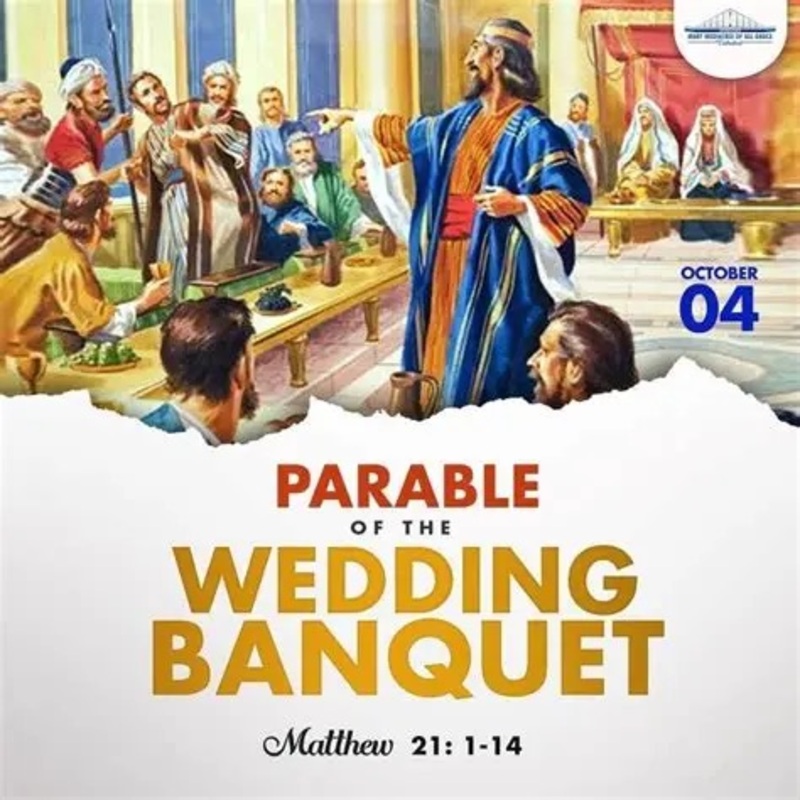
Or – as Jesus described it in the parable – He offers to dress us in His
righteousness. That was the party clothes that each of the wedding
guests was offered. The ones who put them on were welcomed into
the king’s celebration of his son’s marriage – but the one who wanted
to stay in his own clothes was tied-up and tossed out of the party.
So in this story, you can’t always dress them up.
Yet, God’s grace relentlessly seeks, invites, and escorts us into
His celebration and gives us a seat at His table – because, as the old
saying doesn’t go, “You can take them out”.
God meets us when we are hopelessly mired in sin – facing spiritual
death – and provides the righteousness – the clean, white wedding
garment required to dwell at His table forever.
We don’t need to "get our act together" or "clean ourselves up" before
coming to God. God is not waiting for us to undergo some self-
improvement work before He will let us in. If that were the case, we
could never get ourselves cleaned up well enough to get invited in.
Thank God that He calls us where we are – and as stained and as
flawed as we are – and wraps us up in His own righteousness.
All that we need to do is to admit that we are NOT good enough, smart
enough, strong enough, or rich enough to gain entrance into His
Kingdom.
Ironically, all that is required is that we be humble enough and grateful
enough to accept the gift of God’s Grace in Jesus Christ. But if we put
on false humility – a façade of humility – we will remain lost.
The original, self-righteous invited guests made light of the king's feast
and refused to come, trusting in their own status and business savvy.
So, the king sent servants out into the main roads to gather anyone
they could – the good and the bad alike. All they had to do was say,
“Yes,” to the invitation.
We are those people from the highways and byways of life. We may
be unpolished, messy, and unable to make ourselves fit for a royal
palace. But the sacrifice of Jesus makes us fit.
I guess you could call it “Cross Fit.” The Cross of Jesus makes us fit to
stand in the presence of God in eternity.
Before we wrap this up - you may still be wondering about the poor guy
who didn’t have the right clothes for the wedding. That doesn’t seem
to fit with Jesus’s teachings about God’s grace. So we need a little
historical context for it to make sense.
At ancient royal weddings, the host provided robes for the guests –
so that everyone would be wearing the same kind of clothes. That was
a way of keeping the guests from separating themselves into groups of
different social classes. The man without a wedding garment wasn't
kicked out because he was poor; he was expelled for rejecting the free
wedding robe offered by the King.
Jesus’s point is that He takes us out of our spiritual poverty and
dresses us up with His righteousness. As we sing in the old Gospel
hymn, we will be “Dressed in His righteousness alone, faultless to
stand before the throne.” We cannot dress ourselves up — God
clothes us with the righteousness of His Son.
We just have to be humble enough to get over ourselves and let Him
do it.
Stop waiting to get clean to come to the party: Come in your mess,
and joyfully receive the robe of righteousness that Jesus offers.
And then – as servants of the King – go to the "street corners" of our
community. Invite the unpolished, the hurting, and the forgotten without
pre-conditions – and offer them a seat at Jesus’s table.
Praise God that while we could never dress ourselves up to earn a
place at His table, His grace took us out of darkness and robed us in
Jesus Christ. And pray that He will continue to do that for others
through our witness. Amen.