
A common theme in folktales is: “Be careful what you wish for.”
Diane has her own version of that adage: “Be careful whom you date.
You might marry him.”
Countless stories tell of a person who is granted wishes – often three
of them at a time – and the havoc that can follow the granting of a
wish, which forces the person to use the last wish to undo one or both
of the first two.
Way, way back in 1697, the French author Charles Perrault wrote a
story called “The Ridiculous Wishes.” In it, a poor woodcutter
complains about being poor and not having enough to eat for his wife
and himself. A fairy or spirit or the Roman god Jupiter – depends upon
the version you read – gives him three wishes. When he gets home,
his wife tells him to sleep on it and make his wish the next day.
While sitting by the fire that next day, the woodcutter wished for
sausages. His wife berated him for his foolish choice, and when he
had had enough of her complaining, he wished that the sausages
would attach themselves to her nose. Which made her complain all
the more. And so, he had to use the last of the wishes to have the
sausages removed from his wife’s nose.
So all he got out of his three wishes were some sausages to eat.
The world we live in is filled with choices. Anyone here remember
when the only channels you could get on TV were 7 and 9? And
maybe some Pittsburgh stations if you had a good antenna and lived
on a hilltop? Then came cable, with what seemed like a bountiful
selection of broadcast channels and eventually cable-only
programming like CNN and MTV.
Now – with internet streaming services on TV – the options are mind-
boggling. And I can’t tell you how many times Diane and I started to
watch something that sounded promising – but were so disappointed
that we shut it off. Or worse – we watched it all the way through and
decided, “That was a waste of perfectly good time that we can’t get
back!”
Remember when the cereal aisle at the store was only half of one side
of the aisle? Now we have a dizzying array of colorful boxes and
countless varieties of the same basic cereals. Cheerios used to be
one of the basic cereals: not sweet, not fancy – just good for you.
And there was one kind – plain – take it or leave it. Then there was the
honey nut variety.
Now there’s apple cinnamon, strawberry with protein and oat crunch
with chocolate or almonds, fruity, heart shapes, very berry, hearty nut
medley with maple cinnamon, confetti with sprinkles – and I’m sure
there are more in the works.
Every day, we are asked to make choices like that – which, when we
think about it, don’t make much difference – unless someone has food
allergies. But there are many choices that matter – a lot.
What is worth our time, our energy, and our devotion? We are
confronted with overwhelming demands, complex decisions, and
endless distractions – and so what should we do?
And we have to decide whom we should trust.
Let’s put ourselves in the place of young King Solomon. His father,
the legendary King David – the man after God’s own heart – has died.
Solomon – who was not first in line to succeed him – winds up on the
throne. He was twenty years old at the time.
One night, God appeared to Solomon in a dream and offered him
anything he wanted. Solomon knew he was in over his head and
asked God for “a discerning heart” – literally, “a listening heart” –
a heart that listened for God’s voice and sensed God’s promptings.
To govern (God’s) people and to distinguish between right and wrong.
He was asking for wisdom – with a good dose of discernment.
Good answer, Solomon! God was pleased – and told Solomon He
would do what he asked – give him wisdom. But God would also give
Solomon all the things that ordinary rulers would have asked for – but
which Solomon did not request. God gave him long life, wealth, victory
over his enemies, and discernment on top of wisdom.
You see, a discerning heart does not seek knowledge on its own –
it seeks to walk with God, listening to His voice and obeying His
commands. This is what many people call “the walk of faith.”
This walk is all about discernment. In Matthew 13, Jesus gives his
followers a masterclass in discernment – broken up into a series of
parables. He compares the Kingdom of Heaven to:
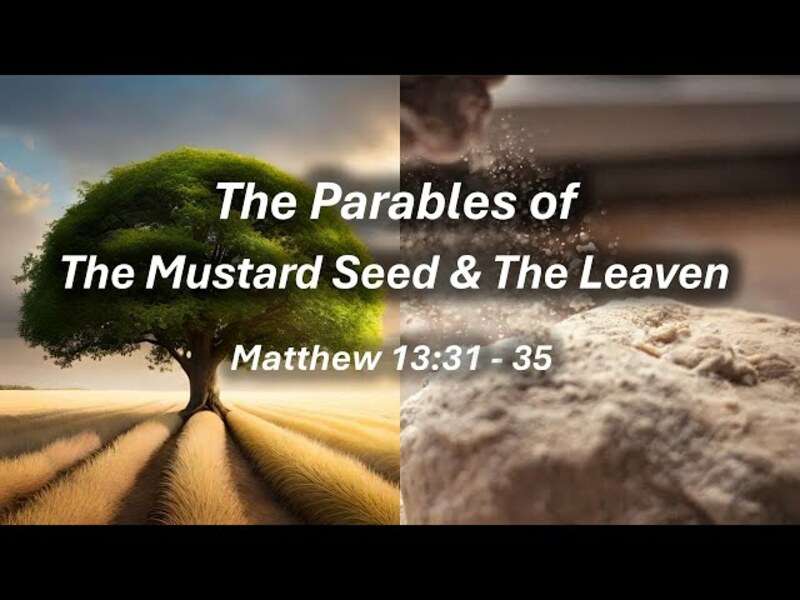
A tiny mustard seed that grows into a great tree. Mustard plants
in Palestine could grow 15 feet tall.
A pinch of leaven or yeast which multiplies rapidly and puffs up a
big batch of dough.
A hidden treasure in a field – and the wisdom of a man who sells
everything and buys the field.
A man who sells everything to buy a pearl of great value – which
will grow in value – or make his wife supremely happy.
A dragnet gathering fish of every kind, including the undesirable
kind of fish – all of which will be sorted once the boat is back on
shore.
A mustard seed looks insignificant.
A pinch of yeast disappears in the flour.
A treasure in a field goes unnoticed by passersby.
The world measures value by size, power, and glitter.
A discerning heart sees what the world overlooks –
because it has the eyes of faith.
Discernment allows us to recognize where God is quietly at work – in
the still, small voice – not in the thunderstorm or the wildfire.
We have to remember how – in these parables – people reordered
their lives to acquire what they treasured. And they did it with joy.
The man who found the treasure and the merchant who found the
pearl didn’t act out of obligation or coercion – they sold everything they
had with joy because they knew they could have what truly mattered.
And what truly matters is a life that prepares us for the Kingdom of
God. We may have to reorder it, make sacrifices, let go of old hurts or
grudges, be less consumed with what the world thinks and be fully
consumed by what God thinks.
And we can do this – as challenging as this might be – because we
don’t do it alone. I am fond of saying that I could not get up in the
morning without the eighth chapter of Paul’s letter to the Roman
Christians. Especially verses 1 & 2:
“…there is now no condemnation for those who are in Christ Jesus,
because the law of the Spirit of Life in Christ Jesus set me free from
sin and death.”
And verse 26:
“In the same way, the Spirit helps us in our weakness. We do not
know what we ought to pray for, but the Spirit himself intercedes for us
with groans that words cannot express.”
And ultimately – when we feel that nothing is going right and our lives
are about to go over a cliff – a discerning heart keeps beating because
of the promise of Romans 8: “Nothing can separate us from the love of
God, which is in Christ Jesus our Lord.” Not hardship, not distress, not
persecution, nor anything else in all creation.
Every day, the treasures of this world try to distract our attention, trying
to convince us to chase after treasures that can be lost or stolen, or we
can see fading away. But God offers us something far more lasting and
far better — listening, discerning hearts.
Amen.