
Genesis 1:1-27 & Matthew 28:16-20
About a month after Pope Leo the 14 th was elected to replace the late
Pope Francis last year, he told a delegation of Roman Catholic church
groups meeting in Rome, “The Christian life is not lived in isolation.
It is lived with others, in a group and in community, because the risen
Christ is present wherever disciples gather in His name.”
Can I get an “Amen” to that?
Creating the universe and everything in it was a group project.
In Genesis 1 God starts the whole creation process by saying,
“Let there be light” – and light appeared. Then God separated the light
from the darkness, and created the earth by separating the matter
above from the matter below. Then He separated the land from the
seas, created plants, the sun and the stars and the other planets, then
fish and sea creatures, birds and animals of all sorts.
For each of the first five steps in the process, God said, Let something
come into being. And each time, God looked at it and said to Himself,
“It is good.”
But something was missing. So God said, “Let us make man in our
image.” Who is the “us” in that statement? Is God using the
“Royal we” that Queen Victoria is said to have used when one of her
attendants told a risqué joke in her presence, stating “WE are not
amused!”
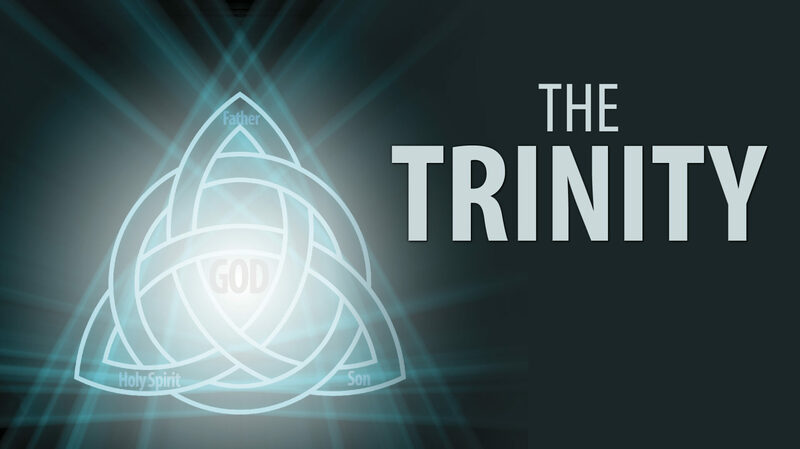
No – God says “Let us” because the Trinity of Father, Son, and Holy
Spirit have always existed in a supernatural unity that is both glorious
and mysterious. As the Council of Nicea put it in its Creed:
We believe in one God, the Father, the Almighty, maker of heaven and
earth, of all that is, seen and unseen. We believe in one Lord, Jesus
Christ, the only Son of God, eternally begotten of the Father, God from
God, Light from Light, true God from true God, begotten, not made,
of one Being with the Father; through him all things were made.
We believe in the Holy Spirit, the Lord, the giver of life, who proceeds
from the Father and the Son, who with the Father and the Son is
worshiped and glorified, who has spoken through the prophets.
So when God said, “Let us make mankind in our image” – it was a
group effort of the Father, Son, and Holy Spirit – forming Adam out of
the dust of the earth and breathing the breath (or Spirit) of life into him.
I believe that the change in wording from “Let” – as in “Let there be
(something)” to “Let us” – for the creation of human beings – is both
deliberate and significant.
Not only do we bear the image of God in terms of creativity and the
ability to love, but we also share God’s image in our humanity. We
have a sense of right and wrong and our desire to see justice served –
especially for our fellow human beings who also bear God’s image.
Likewise, our compassion for others is derived from God’s image.
God so loved the world that He gave His only-begotten Son …
that whoever believes in Him should not perish but have eternal life.
As if that were not enough – Jesus is now sitting at the right hand of
his Father and is interceding for us, as Paul wrote to the Roman
Christians. And if we take a long, deep look at ourselves, we should
conclude that that is a full-time job for Jesus!
But He does it because He created us in His image – and while His
image in us is often blurred and even obscured by our sinfulness –
He continues to love us and intercede for us: “Father, I know David
can’t get much of anything right, let alone holiness – but he’s one of
my sheep and I’ll keep chasing after him and bringing him back to
the fold until You bring him permanently into my kingdom.”
That is how much Jesus desires the “us” of the kingdom of God.
He wants unity in His Church. Not necessarily unity in style of worship
or form of baptism or only one acceptable translation of the Bible –
but unity around the simple doctrine of “Jesus is Lord.” And Paul wrote
to the Corinthian Christians, “no one can say, ‘Jesus is Lord,’ except by
the Holy Spirit.”
And while we come into the kingdom as individuals – generally
speaking – it is only together in the Church (with a capital C) that we
are the body of Christ. And you may have thought that we want people
to become members so we can get their money, have some younger
backs to help out, and have a bigger number in the presbytery
membership reports.
Those may be issues of secondary importance – but the real reason
is that we want to see the Kingdom of our Lord Jesus Christ grow.
His Church needs more of us – seekers, disciples, servants, and
worshippers of all abilities, ages, backgrounds, and degrees of faith.
The Apostle Paul put it this way in I Corinthians 12:
Just as a body, though one, has many parts, but all its many parts
form one body, so it is with Christ. For we were all baptized by
one Spirit so as to form one body—whether Jews or Gentiles,
slave or free—and we were all given the one Spirit to drink.
Even so the body is not made up of one part but of many.
Now if the foot should say, “Because I am not a hand, I do not
belong to the body,” it would not for that reason stop being part of
the body. And if the ear should say, “Because I am not an eye, I
do not belong to the body,” it would not for that reason stop being
part of the body. If the whole body were an eye, where would the
sense of hearing be? If the whole body were an ear, where would
the sense of smell be? But in fact God has placed the parts in the
body, every one of them, just as he wanted them to be. If they
were all one part, where would the body be? As it is, there are
many parts, but one body.
And may I add, each of those many parts is essential to the functioning
of the body.
Which brings up one of the great deceptions of our age: the idea that
there is no such thing as objective truth. We hear interviewers on
podcasts, radio, and TV asking the person being interviewed for his
or her “truth.”
That thinking is especially dangerous in the Church – where the Word
of God with a capital W is understood to be Jesus Christ – and the
Bible is the written words of God. How much wiggle room can there be
when God’s words are clear about what we should believe and how we
should live? And do we have any leeway in what parts we chose to
believe and those we can reject? What do we do when too much
leeway demolishes our unity?
In our reading today from Genesis – it is the Triune “Us” who created,
and in our reading from Matthew’s account of the Gospel that the
Triune “Us” sends you and me into the world to share the Good News,
to challenge the world to embrace that Good News, and then put the
Good News into action – knowing that we don’t do it alone. Let us get
busy doing it. Amen.