
* Exodus 17:1-7
* Psalm 95
* Romans 5:1-11
* John 4:5-42
How many of you remember the diesel fuel spill on the Monongahela River
in January of 1988? I remember it better than I remember yesterday. An
Ashland Oil Company tank near Floreffe in Allegheny County collapsed –
spilling almost four million gallons of diesel – more than 750-thousand
gallons of which ended up in the river and created a 33-mile-long slick.
Many municipalities along the Mon and the Ohio Rivers had to shut down
intakes for their water systems to prevent contaminating them. Very few
communities had alternative water sources – so millions of people lost water
service for several days.
I was a reporter for WWVA Radio at the time – and all of us in the
newsroom were working around-the-clock to keep the public informed about
when the water would be shut off – when it would be restored – and where
to get clean drinking water. I logged 120 hours that week – including one
30-hour shift.
In the interest of full disclosure, some of those hours were spent keeping the
Associated Press up-to-date, and preparing extended reports for National
Public Radio and several national radio networks.
That is how important water is to life – and to what extent people will go to
get water to drink. Many of us – and I include myself – didn’t realize how
precious it was until we didn’t have it.
Thirst has a way of shrinking everything down to one urgent question:
“Where will I find something to drink?” In today’s Scripture readings, we see
that thirst is more than a bodily sensation; it becomes a window into the
soul. Thirst threatens our comfort and our health – and our discomfort and
fear rise to the surface.
Today we read two accounts of thirsty people: Israel in the wilderness, and a
Samaritan woman at a well.
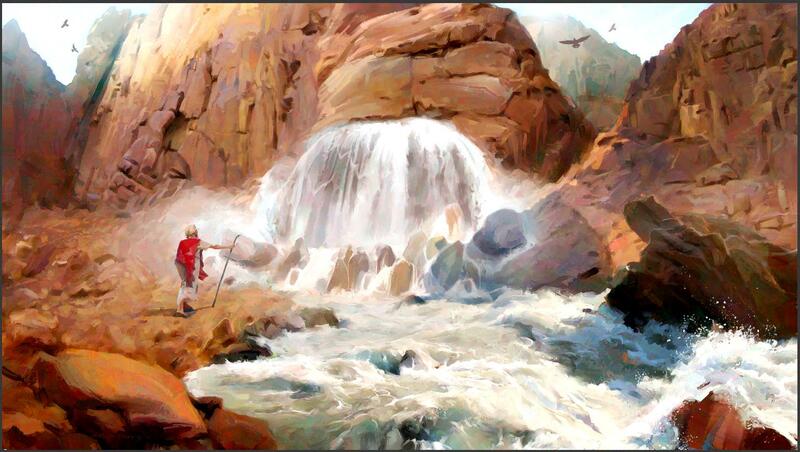
In Exodus 17, water comes from a rock in a place called Massah and
Meribah – which are translated as “testing” and “quarreling.”
Then in John 4, Jesus offers “living water” that becomes a spring inside a
person. The questions underneath both stories are the same: Where is
God? Will God give us what we need? Will God meet us here?
The good news is that God will not only meet our thirst, but He will also use
it to lead us to Himself.
Our story from Exodus 17 finds the people of Israel traveling from Egypt to
the Promised Land as the Lord commanded, and then coming to Rephadim,
which was a place with no water.
This was not an inconvenience. In a desert, having no water is a genuine
emergency. Israel’s thirst was real – and there was a real danger of death.
The people are panicking – and are getting angry with Moses. Essentially,
they are demanding that he give them water. As though he were God –
who was over the waters before the creation of the world.
And Moses hears something deeper than a request; he hears accusation:
“Why did you bring us up out of Egypt, to kill us…?” Their thirst becomes a
courtroom, and they are putting God on trial. Openly suggesting that God –
through Moses – set them up to die of thirst in the desert.
The names of the place tell the story: Meribah (quarreling) and Massah
(testing), because they asked, “Is the Lord among us or not?”
This is too much for Moses – who cries out, “What shall I do with this
people? They are almost ready to stone me.” Sometimes spiritual
leadership looks like standing between desperate people and a holy God
with empty hands, praying, “Lord, if You don’t act, we are done for.”
And God responds favorably – in spite of their unbelief. The Lord tells
Moses to take the staff—the same staff he associated with judgment and
deliverance—and to go on ahead with the elders.
Then God says something astonishing: “I will stand before you there on the
rock at Horeb.” Then Moses is supposed to strike the rock, and water will
come out for the people to drink.
Notice what is happening. The people question whether God is present, and
God answers by making His presence unmistakable: “I will stand before
you.” The people deserve punishment, but God gives provision. He does not
wait until their tone is perfect or their faith is strong. He meets them in the
wilderness with water from a rock.
In our companion reading from John 4 – Jesus is traveling through Samaria.
He sits by Jacob’s well at midday, tired and thirsty. A Samaritan woman
comes to draw water, and Jesus begins with a simple request: “Give me a
drink.” The same Son of God who was with the Father and the Spirit,
hovering over the mysterious waters – and then made the oceans – asks
a gentile woman for a cup of water.
Everything about this scene involves barriers: a Jew and a Samaritan – who
were to have nothing to do with each other. It also involved an unmarried
man and an unmarried woman – which could have generated a scandal –
an expert in the Jewish law and a woman whose life was not in keeping with
the Law given to Moses.
Btu Jesus wants her to experience Him – the living water – so He bridges
their differences gently: He does not shame her; rather, He begins by asking
a favor of her: “Will you give me a drink?”
This is a flesh-and-blood (or should I say, flesh-and-water) example of how
Jesus gave up the glory He had in heaven to come to earth to live with us
and to experience life as we do. Including getting thirsty.
Then Jesus turns the conversation to Himself: “If you knew the gift of God…
you would have asked Him, and He would have given you living water.”
She assumes Jesus means running water – from a stream – rather than
well water. Better tasting water. Easier water to get.
But Jesus is speaking about the life God offers to thirsty souls – so He
names this woman’s deeper thirst:
“Everyone who drinks of this water will be thirsty again, but whoever drinks
of the water that I will give him will never be thirsty forever. The water that I
will give him will become in him a spring of water welling up to eternal life.”
Wells run dry. Buckets empty. Rivers are contaminated. Relationships
disappoint. Achievements fade. But Jesus Christ offers a gift that doesn’t
depend on circumstances. He offers to give us His life in us – because
He is the “Living Water.”
When she asks for this water, Jesus forces her to confront the dead life she
has been leading. He tells her, “Go, call your husband…” She is forced to
confess that she doesn’t have one. Which is true – she has had five
husbands – and is now living with a sixth man, who is not married to her.
Jesus’s revelation of the ugly truth is not intended to be cruel – it is meant
to be liberating. He points out that she has tried to satisfy her thirst with a
series of relationships that cannot hold water.
The conversation then turns to worship—where to worship, which mountain,
which tradition? Jesus answers with an entirely different location – in the
heart: “The hour is coming… when the true worshipers will worship the
Father in spirit and truth.” Then, as she speaks of the coming Messiah,
Jesus gives one of His clearest self-revelations in the Gospels: “I who speak
to you am He.” The living water is not a thing; it is a Person. It is Jesus.
When we look at Exodus 17 and John 4 together we can see a common
thread: God meets real thirst with real provision, and He does it in a way
that reveals His heart.
In the wilderness, the question was, “Is the Lord among us or not?” In John
4, the answer is sitting by a well, asking for a drink. God is not only above
us, but He has also come to dwell among us in His Son Jesus Christ.
Exodus says God “stood” at the rock, and the rock was struck so that water
could flow to the people. Paul reflected on this provision in the wilderness
and wrote, “the Rock was Christ”. Before going to the cross, Jesus was
struck – wounded for our transgressions and bruised for our iniquities —so
that God’s grace could flow to undeserving people like us.
While the Israelites in the wilderness did not understand all of that in the
moment – but we can look back and see that God has always been the One
who brings life from that which looks lifeless.
And the water Jesus gives is more than temporary relief of thirst. It becomes
“a spring, welling up to eternal life.” This is the inner renewal of the Holy
Spirit: God not just supplying what we lack, but changing what we love,
reshaping us, and teaching us to drink deeply of Him.
Amen.